
Media Sharing
Get More from ICL Directly to Your Inbox
Premier visibility for railcar tracking & management
Trusted 3PL expertise for finished vehicle logistics
End-to-end visibility for finished vehicle shippers
Turnkey solution to manage your yard operations
Optimize or design your transportation network with ease
Streamline your load for maximum efficiency
Even more custom service solutions to support all your logistics needs
We're proud to be a leader in product visibility and invoice auditing solutions throughout the logistics supply chain. Learn more.
Looking to join our team of award winning experts? Check out our open positions now.
We want to hear from you! Get in touch with us today.
For the fine print on our privacy policy, cookies and data, & more.
See how we keep your data safe with certified security practices, secure systems, and constant monitoring.
Sustainability in finished vehicle logistics is not only about future technology.
It is also about how well carriers use the trucks and trailers they already have.
When trailers leave with open space, trucks run unnecessary empty miles, or drivers spend time repositioning without freight, the operation loses money.
It also creates avoidable emissions.
For finished vehicle carriers, better fleet planning can support both goals: stronger operating performance and more sustainable transportation.
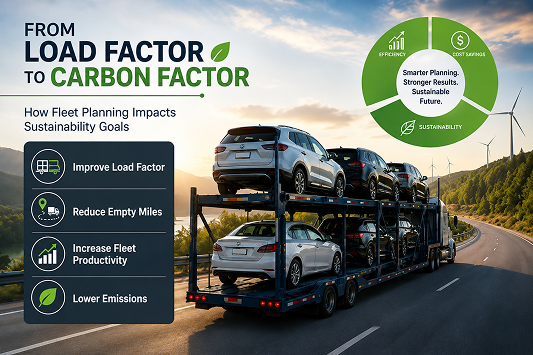
That starts with load factor.
Load factor measures how effectively trailer capacity is used.
In simple terms, it shows how much of the available trailer space is producing value.
Carbon factor looks at the emissions impact of transportation activity.
The two are connected.
When load factor improves, carriers can often move more vehicles with fewer trips. That can help reduce unnecessary fuel use, lower avoidable miles, and improve emissions intensity per vehicle moved.
This does not mean emissions disappear.
It means better planning can help reduce waste in the transportation process.
For carriers, that matters because every inefficient trip has two costs.
A financial cost.
And an emissions cost.
Empty miles, or deadhead miles, happen when a truck moves without a load.
In finished vehicle logistics, some empty repositioning is unavoidable.
But unnecessary empty miles create waste.
The truck still burns fuel. The driver is still on the clock. Equipment still wears down. Emissions are still produced.
But no vehicles are being moved.
For carriers, empty miles reduce margin.
For OEMs and logistics customers, they also add emissions to the outbound supply chain.
Reducing unnecessary empty miles helps carriers improve fleet productivity while supporting broader sustainability goals.
Carriers often think first about cost, capacity, drivers, and revenue per truck.
That is the right starting point.
But many of the same actions that improve profitability can also support sustainability.
Better load planning can help reduce wasted miles.
Improved trailer utilization can help move more vehicles with the same fleet.
Higher load factor can reduce the need for extra trips.
Faster planning can help dispatchers respond to changes before they create inefficient moves.
These are operational improvements.
They are also sustainability improvements.
For carriers, sustainability does not need to be separate from the daily work of protecting margins. In many cases, it starts with reducing waste inside the transportation plan.
Manual load planning puts dispatchers under pressure.
They need to build loads, react to changes, manage drivers, coordinate equipment, and keep freight moving.
When planning is manual, teams often focus on solving the immediate move.
Can this truck take this load?
Can this driver cover the route?
Can we get the vehicles delivered on time?
Those questions are important.
But they do not always show what happens next.
A load may work for today, but leave the truck in a poor position for the next move. That can lead to more empty repositioning, lower trailer productivity, and higher emissions per vehicle moved.
Manual planning also makes it harder to see patterns.
Where are empty miles increasing?
Which routes have lower load factor?
Where are trucks waiting or repositioning too often?
Without better planning visibility, these issues can stay hidden.
Total emissions matter.
But in finished vehicle logistics, emissions intensity also matters.
Emissions intensity looks at emissions in relation to the work being done, such as emissions per vehicle moved.
When a truck carries fewer vehicles than it could, the emissions impact is spread across fewer units.
When the same truck moves more vehicles efficiently, emissions per vehicle may improve.
That is why load planning is an important sustainability lever.
Better vehicle load planning helps carriers improve load factor, reduce avoidable trips, and make better use of each trailer.
This does not replace larger sustainability initiatives.
It supports them.
Fleet planning is one of the practical places where carriers can take action now.
Truck utilization is not only a productivity metric.
It also affects fuel use, empty miles, and emissions.
A truck that is underloaded, waiting for a revised plan, or repositioning empty is not being used efficiently.
That creates waste across the operation.
Better utilization means more productive movement from the same asset.
For carriers, that can support revenue per truck and cost control.
For logistics customers, it can support more efficient outbound transportation.
The strongest operations look at utilization beyond whether a truck is moving.
They ask whether the truck is moving profitably and efficiently.
That same question supports sustainability.
Finished vehicle logistics requires detail.
A vehicle’s dimensions, weight, destination, handling requirements, and delivery priority can all affect load planning.
That is why VIN-level data matters.
Better vehicle data helps planners build more accurate loads. It also helps teams understand transportation activity at a more detailed level.
If carriers and logistics customers want better emissions visibility, they need better data about the movement itself.
Which vehicles moved?
How were they loaded?
What route was used?
Where did empty miles occur?
What mode or segment created the emissions?
This is especially important as emissions reporting becomes more common across finished vehicle logistics.
Accurate data supports better decisions.
Better decisions support lower waste.
Transportation emissions are becoming a bigger part of logistics conversations.
OEMs and logistics customers are under pressure to understand, report, and reduce emissions across the supply chain.
For many OEMs, outbound finished vehicle transportation falls under Scope 3 emissions because the transportation is performed by third-party logistics providers.
That means carrier operations can influence the emissions profile customers need to report.
Cost, transit time, and quality will continue to matter.
But emissions visibility is becoming part of the logistics scorecard.
Carriers that can support better planning data, reduce avoidable waste, and provide stronger visibility may be better positioned as customers advance their sustainability goals.
ICL’s AutoLoad Planner helps finished vehicle logistics teams improve load planning with better data, stronger visibility, and smarter optimization.
It uses VIN-level data, vehicle specifications, delivery timing, routing preferences, and truck capacity to support better load decisions.
For carriers, AutoLoad Planner helps improve load factor, support multi-destination tour planning, reduce manual planning time, and make more consistent load planning decisions.
It also provides visibility into truck utilization and empty miles, helping teams identify opportunities to reduce unnecessary repositioning.
With optional greenhouse gas emissions tracking, AutoLoad Planner can also support teams that want to connect load planning decisions with sustainability reporting and emissions visibility.
The goal is practical.
Use available assets better.
Reduce unnecessary miles.
Give dispatchers better planning options.
Support stronger fleet productivity and more sustainable operations.
AutoLoad Planner does not eliminate every empty mile or guarantee emissions reductions.
No planning system can do that.
But it helps carriers make better planning decisions that can reduce waste and support sustainability goals.
Sustainability is not only shaped by long-term investments.
It is also shaped by daily planning decisions.
Which vehicles move together?
How full is the trailer?
How much empty repositioning is required?
Can the route support the next move?
How much time is lost before dispatch?
These decisions happen every day.
Each one affects cost, productivity, and emissions.
Better fleet planning gives carriers a way to reduce waste while improving the business.
Fleet planning sustainability starts with better use of available assets.
When carriers improve load factor, reduce unnecessary empty miles, and use better planning data, they can support both margin protection and emissions reduction goals.
For finished vehicle logistics teams, this is a practical path forward.
It does not require waiting for the next generation of equipment.
It starts with smarter planning today.
ICL’s AutoLoad Planner helps carriers improve trailer utilization, reduce manual planning work, identify empty mile opportunities, and support more sustainable fleet planning through optional GHG emissions tracking.
Request a personalized demo of AutoLoad Planner to see how ICL can help your team improve load factor, reduce unnecessary empty miles, and support smarter fleet planning sustainability.