
Media Sharing
Get More from ICL Directly to Your Inbox
Premier visibility for railcar tracking & management
Trusted 3PL expertise for finished vehicle logistics
End-to-end visibility for finished vehicle shippers
Turnkey solution to manage your yard operations
Optimize or design your transportation network with ease
Streamline your load for maximum efficiency
Even more custom service solutions to support all your logistics needs
We're proud to be a leader in product visibility and invoice auditing solutions throughout the logistics supply chain. Learn more.
Looking to join our team of award winning experts? Check out our open positions now.
We want to hear from you! Get in touch with us today.
For the fine print on our privacy policy, cookies and data, & more.
See how we keep your data safe with certified security practices, secure systems, and constant monitoring.
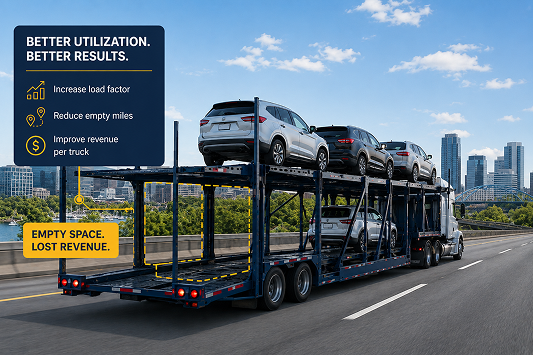
A busy truck is not always a profitable truck.
In finished vehicle logistics, profitability depends on more than movement. It depends on load factor, route sequencing, empty miles, driver time, and how quickly dispatch teams can adapt when VINs, priorities, or capacity change.
A truck that is waiting, repositioning empty, or running an inefficient load is not working at its full value.
That matters when margins are tight, driver availability is limited, and customers expect faster delivery performance.
Improving truck utilization starts with better load planning.
Truck utilization is often treated as a simple question.
Is the truck moving or not?
For carriers, the better question is this:
Is the truck moving profitably?
Strong utilization means the truck is completing more work with less waste between moves. It means drivers spend more time hauling and less time waiting. It means trailers are loaded efficiently and positioned for the next opportunity.
The best carrier operations look at utilization through a financial lens.
How many loads can each truck complete per week? How much revenue can each trailer generate? How much time is lost between dispatch, pickup, delivery, and the next load?
Those answers show whether the fleet is truly productive.
Finished vehicle logistics is complex because every load is different.
Vehicles have different dimensions. Destinations vary. Delivery priorities change. Trailer configurations matter. Yard conditions can shift throughout the day.
A dispatcher may need to balance vehicle fit, route sequence, truck capacity, delivery timing, driver hours, and customer expectations all at once.
Then something changes.
A VIN goes on hold. A priority vehicle is added late. A truck becomes unavailable. A delivery window moves. A driver runs short on available hours.
The plan has to change quickly.
That is why improving truck utilization is not as simple as filling more trailer space. It requires load planning that can adapt to real-world carrier operations.
Manual load planning can limit truck productivity.
Dispatchers may know the fleet, the routes, and the drivers extremely well. But when planning is done through spreadsheets, phone calls, emails, or static rules, it becomes difficult to evaluate every possible load combination fast enough.
A load may be good enough to move.
But it may not be the best load for trailer productivity, route efficiency, driver time, or the next revenue opportunity.
That gap matters.
Manual planning can also create more rework. When inventory changes, dispatchers may need to rebuild loads from scratch. That slows execution and can leave trucks waiting.
The issue is not dispatcher skill.
The issue is that manual planning does not scale well under daily pressure.
A higher load factor helps carriers move more vehicles with the same trucks.
That can improve revenue per trailer and reduce the need for extra trips.
But the goal is not to force every possible vehicle onto a load at the expense of service quality. A poorly sequenced load can create delays, extra miles, or downstream delivery problems.
Effective load planning balances trailer capacity, delivery sequencing, and driver productivity without creating downstream delays.
It considers which vehicles fit, which destinations work together, which deliveries are time-sensitive, and which route makes operational sense.
When load factor improves without hurting service, carriers get more value from the fleet they already have.
Empty miles reduce truck utilization because the asset is moving without producing revenue.
Some empty repositioning is unavoidable in finished vehicle transportation. But avoidable deadhead should be reduced wherever possible.
That requires planning beyond the current load.
A dispatcher may build a load that works for today’s move, but leaves the truck far from the next revenue-producing opportunity. That can lead to extra repositioning, wasted driver time, and lower revenue per truck.
Better planning looks at the full asset cycle.
Where will the truck be after delivery? Can the route support a stronger next move? Will the driver be positioned for another load?
Reducing unnecessary empty miles helps improve utilization and protect margin.
Driver time is one of the most important parts of truck utilization.
A truck cannot be fully productive if the driver is waiting for a load plan, sitting through rework, or repositioning empty too often.
Poor planning creates frustration.
Drivers want clear assignments. They want fewer delays. They want to keep moving.
Better load planning helps reduce idle time and gives dispatchers a stronger path to keep drivers productive.
This matters for performance.
It also matters for retention.
When drivers feel their time is respected, the operation runs better.
Dispatch teams are under constant pressure.
They need to assign loads, manage changes, coordinate drivers, respond to customers, and keep equipment moving.
Manual planning adds more work to an already demanding role.
When dispatchers have to rebuild loads by hand, they lose time that could be spent managing exceptions and improving execution.
A stronger planning process gives dispatchers better starting points.
Instead of manually testing every option, they can review optimized load recommendations, make adjustments, and move faster.
That supports better utilization because trucks spend less time waiting on the planning process.
Finished vehicle logistics requires detailed data.
A sedan, SUV, truck, EV, or specialty model can each affect how a trailer should be loaded. Vehicle dimensions, delivery priority, destination, and handling requirements all matter.
VIN-level data helps planning teams make more accurate decisions.
It reduces the guesswork that comes from relying on memory, static reference sheets, or incomplete information.
Better data supports better trailer fit, stronger sequencing, and fewer planning errors.
That is especially important as vehicle mixes continue to change.
The more accurate the planning input, the stronger the load plan can be.
Truck utilization should not be judged by one trip alone.
The better measure is how well the truck performs across the full week.
A carrier may build a load that looks efficient on its own, but creates downtime after delivery. Another load may support a better next-leg opportunity and improve total turns per truck.
That is the difference between planning a shipment and planning an asset cycle.
Carriers should look at how load planning affects reload timing, next-move positioning, driver availability, and weekly output.
More turns per truck means more work from the same equipment.
That is where utilization becomes real financial value.
ICL’s AutoLoad Planner helps finished vehicle carriers and logistics teams improve load planning with better data, stronger visibility, and smarter optimization.
It uses VIN-level data, vehicle specifications, delivery timing, routing preferences, and truck capacity to support better load decisions.
AutoLoad Planner helps teams move from manual load building to optimized planning. In practice, that means fewer planning bottlenecks, better trailer utilization, and faster decisions when inventory or delivery priorities change.
For logistics teams, the impact is measurable:
Dispatchers can spend less time rebuilding loads manually. Trucks can be planned more efficiently. Drivers can spend more time moving revenue-producing freight. Leaders can make better use of available equipment without immediately adding more trucks or headcount.
AutoLoad Planner does not replace dispatcher judgment.
It supports it.
The dispatcher still manages exceptions, driver needs, customer requirements, and final decisions. The system helps them get to a stronger plan faster.
Truck utilization is not only a fleet issue.
It is a planning issue.
If loads are built manually, inconsistently, or without enough visibility, trucks will not reach their full revenue potential.
Smarter planning gives carriers better operational control before a truck ever leaves the yard.
It helps improve load factor, reduce unnecessary empty miles, shorten planning cycles, and position trucks for the next revenue-producing opportunity.
That is how carriers can get more from the fleet they already have.
Carriers using automated load planning tools are improving:
In some operations, automated planning has helped increase fleet productivity while reducing manual planning workload by up to 70%.
Improving truck utilization in finished vehicle logistics means more than keeping trucks busy.
It means moving more loads. It means reducing avoidable empty miles. It means improving trailer productivity. It means giving dispatchers better tools and keeping drivers productive.
In a market where adding trucks and drivers is difficult, better planning is one of the most practical ways to improve performance.
ICL’s AutoLoad Planner helps carriers strengthen load planning, improve utilization, and move more revenue-producing loads with the same fleet.
For carriers, better utilization protects margin. For OEMs and 3PLs, it improves delivery reliability, capacity planning, and network performance.
Request a personalized AutoLoad Planner demo to see how your team can improve load factor, reduce manual planning time, and get more revenue-producing moves from the fleet you already have.