Customer complexity
Different customer requirements, reporting expectations,
service priorities, and operating rules.


Premier visibility for railcar tracking & management

Trusted 3PL expertise for finished vehicle logistics

End-to-end visibility for finished vehicle shippers

Turnkey solution to manage your yard operations

Optimize or design your transportation network with ease

Streamline your load for maximum efficiency

Even more custom service solutions to support all your logistics needs

Discover end-to-end visibility for your rail operations like never before

Streamline your finished vehicle logistics processes with the experts

Simplify your yard management operations and unlock new visibility
Add Finished Vehicle Logistics Expertise Without Adding Complexity
Smarter Load Planning for Finished Vehicle Carriers

We're proud to be a leader in product visibility and invoice auditing solutions throughout the logistics supply chain. Learn more.

Looking to join our team of award winning experts? Check out our open positions now.

We want to hear from you! Get in touch with us today.

For the fine print on our privacy policy, cookies and data, & more.

See how we keep your data safe with certified security practices, secure systems, and constant monitoring.
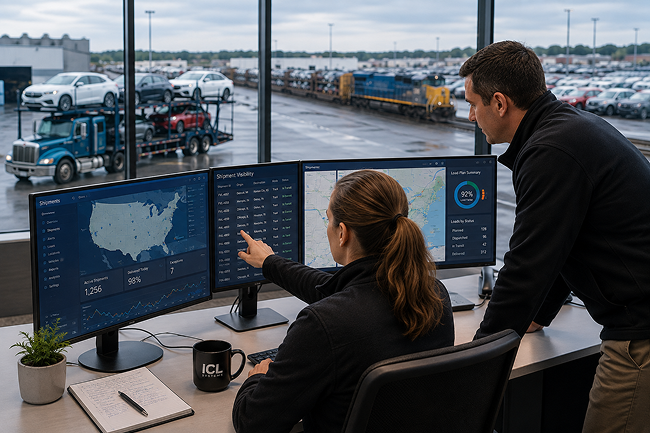
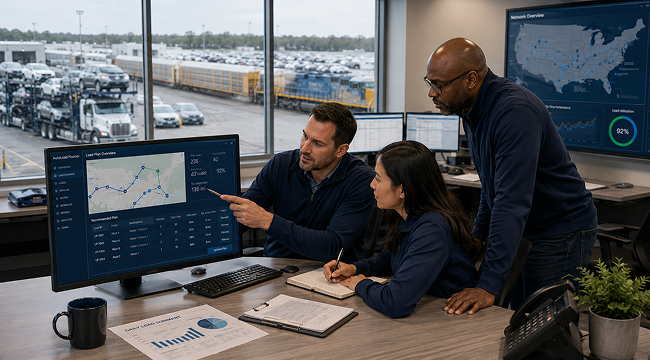
Managing finished vehicle logistics on behalf of customers means coordinating information and activity across carriers, yards, transportation modes, and systems.
Every additional customer can introduce new data formats, carrier relationships, delivery requirements, planning rules, reporting expectations, exceptions, and priorities.
The challenge is not any one system or partner. It is the way complexity compounds across four areas of the operation.
Different customer requirements, reporting expectations,
service priorities, and operating rules.
Multiple carriers, yards, railroads, and other logistics
providers feeding information into the operation.
Connect OEM customer and carrier systems through APIs, web services, EDI (ANSI-X12 and EDIFACT), flat files, Excel template uploads, and webscreen data entry. Bring together plant, rail, truck, ocean, yard, port, and vehicle telematics data in one platform.
ETAs, exceptions, capacity, priorities, handoffs, and
changing plans that require action—not just visibility.
ICL helps connect these moving parts so your team can spend less time reconciling systems and chasing information, and more time managing the network and serving customers.
ICL helps finished vehicle logistics providers connect transportation information across the network and turn it into operational workflows their teams and customers can use.

Bring vehicle status, transportation events, and logistics-provider data together for VIN-level visibility across the finished vehicle journey.

Identify delays, dwell, and other transportation exceptions so teams can focus attention where intervention is needed.

Reduce manual status updates with shared dashboards, scheduled reports, and consistent logistics data.

Support additional customers, partners, and transportation volume without creating another disconnected workflow for every new relationship.

Audit carrier invoices against configured rules, flag billing discrepancies, and track VIN-level costs to support payment approvals and clearer customer cost reporting.

Compare carrier and route performance to identify recurring inefficiencies, support customer performance reviews, and prioritize improvements across your finished vehicle network.

For 3PLs managing finished vehicle transportation, VLMS centralizes and digitizes data from logistics partners across the network.
Use VIN-level transportation information to give operations teams a consistent view of vehicle progress, exceptions, provider performance, and customer reporting.

ICL brings more than three decades of finished vehicle logistics experience to your operation. Our VLMS—used by more OEMs than any other system—also supports automotive 3PLs and 4PLs managing vehicle movements from plant to dealer.
Independent & Neutral: ICL is independent and does not own transportation assets. Your logistics data is managed without bias toward any logistics provider or OEM—helping you deliver objective oversight and transparent reporting across the finished vehicle networks you manage for your customers.
ICL solutions are designed around the requirements of finished vehicle transportation rather than generic freight workflows.
Connect information across truck, rail, ocean, yards, ports, and other finished vehicle handoffs.
Centralize data from transportation partners and reduce the burden of managing fragmented source systems.
Combine technology, data management, and finished vehicle logistics knowledge so internal teams are not left to manage the solution alone.

Knowing what needs to move is only part of the challenge.
When 3PLs also coordinate finished vehicle truck transportation, AutoLoad Planner helps turn VIN-level inventory, delivery priorities, available truck capacity, and routing constraints into practical load plans.

A 3PL often has to accommodate the technology environment of every customer and transportation partner.
ICL supports that complexity with logistics data integration, technical expertise, and additional services designed to reduce the burden on internal teams.
Support operational data quality, logistics-provider coordination, training, and ongoing system use.
Combine logistics information with other business data for reporting, budgeting, analysis, and decision support.
Support the infrastructure and technical environment behind reliable logistics operations.
Address integrations or workflows that do not fit a standard implementation.
YMS Express helps logistics providers digitize vehicle receiving, inspections, parking, staging, and gate-out activity while improving inventory visibility and customer event reporting.
RSVP centralizes rail shipment information, dynamic ETAs, exceptions, and performance analytics to give teams better visibility across rail operations.