
Media Sharing
Get More from ICL Directly to Your Inbox
Premier visibility for railcar tracking & management
Trusted 3PL expertise for finished vehicle logistics
End-to-end visibility for finished vehicle shippers
Turnkey solution to manage your yard operations
Optimize or design your transportation network with ease
Streamline your load for maximum efficiency
Even more custom service solutions to support all your logistics needs
We're proud to be a leader in product visibility and invoice auditing solutions throughout the logistics supply chain. Learn more.
Looking to join our team of award winning experts? Check out our open positions now.
We want to hear from you! Get in touch with us today.
For the fine print on our privacy policy, cookies and data, & more.
See how we keep your data safe with certified security practices, secure systems, and constant monitoring.
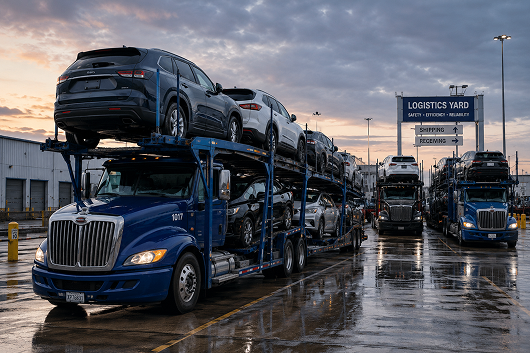
For many finished vehicle carriers, capacity pressure is not only about adding more trucks or drivers. It is also about using existing fleet capacity more efficiently through better load planning.
Every carrier wants the same thing: keep trucks moving, keep drivers productive, reduce empty miles, and complete more revenue-producing loads with the same fleet.
That sounds simple. But in daily operations, it is hard.
Loads change. Vehicles go on hold. Delivery priorities shift. Dispatchers are under pressure. Drivers wait. Equipment sits. Margins get tighter.
These challenges affect not only independent auto haulers, but also OEMs and logistics providers managing dedicated or leased transport capacity.
For years, carriers have relied on experienced dispatchers and planners to make it all work manually.
That experience still matters.
But manual load planning alone cannot keep up with the pace, complexity, and margin pressure of today’s finished vehicle logistics market.
In finished vehicle transportation, time lost in planning can quickly become revenue lost on the road.
A dispatcher may know the best trailer, route, and driver for a load. But they still need to sort through available inventory, vehicle dimensions, delivery timing, equipment capacity, route sequence, and customer requirements.
That takes time.
Then something changes.
A VIN goes on hold. A dealer delivery gets moved up. A truck becomes unavailable. A driver runs out of hours. A unit is added late. A planned load no longer works.
Now the dispatcher has to rebuild the plan.
That rework slows everything down.
The truck is not moving. The driver is not earning. The trailer is not producing revenue.
That is where manual planning starts to cost carriers real money.
Carrier dispatch teams live in constant motion.
They are assigning loads, reacting to changes, managing drivers, coordinating equipment, responding to customers, and trying to keep every truck productive.
Manual planning adds more pressure.
When dispatchers have to rebuild loads by hand, they lose time that should be spent managing exceptions and keeping freight moving.
The result is more chaos.
More calls. More emails. More last-minute changes. More time spent trying to make the load work before the truck can leave.
A better planning process gives dispatchers a stronger starting point.
It helps them move faster, make better decisions, and reduce the daily scramble that drains productivity.
Deadhead is one of the fastest ways to weaken carrier profitability.
Every empty repositioning move uses fuel, driver hours, equipment time, and maintenance cost without producing revenue.
Manual load planning makes it harder to minimize those empty miles because dispatchers are often working under time pressure with incomplete visibility.
They may build the best load they can in the moment, but not always the most profitable load for the route, driver, and trailer.
Reducing empty miles is not just an efficiency goal.
It is a margin protection strategy.
The more miles a truck runs loaded, the more productive that asset becomes.
For carriers, better planning should always connect back to one question:
Can this truck produce more revenue with fewer wasted miles?
Carriers do not just need better truck utilization.
They need more profitable trucks.
A truck that is technically “utilized” but running inefficient loads, waiting too long between turns, or repositioning empty too often is not performing at its full potential.
Carrier leaders look at the business in practical terms.
How many completed loads can this truck handle per week?
How much revenue can each trailer generate?
How much time is lost between assignments?
How often are drivers waiting instead of moving?
How many turns can we complete without adding more trucks?
Manual planning makes those questions harder to answer and harder to improve.
Automated load planning helps carriers focus on the economics that matter most: revenue per truck, loads per week, cost per mile, and trailer productivity.
Driver time is one of a carrier’s most valuable resources.
When trucks wait for a load plan, drivers wait too.
When a load has to be rebuilt, drivers lose productive time.
When poor sequencing creates unnecessary miles or missed reload opportunities, drivers feel the impact directly.
That frustration matters.
Drivers want to move. They want clear assignments. They want fewer surprises and less wasted time.
Better load planning supports better driver utilization.
It helps carriers reduce idle time, avoid unnecessary repositioning, and keep drivers focused on productive moves.
In a market where driver retention is critical, planning efficiency is not just an office issue.
It affects the driver experience.
Finished vehicle transportation changes constantly.
Vehicles are delayed. Dealers change priorities. Yard conditions shift. Equipment availability changes throughout the day.
Manual planning struggles because every change creates more work.
One change can force a dispatcher to rethink the full load, route, and equipment assignment.
That slows response time.
A stronger planning process helps dispatchers react faster.
Instead of rebuilding everything from scratch, they can adjust based on optimized recommendations and current constraints.
That gives carrier teams more control when the day does not go according to plan.
Vehicle dimensions are changing.
Carriers are moving different mixes of SUVs, trucks, EVs, sedans, and specialty models. Each vehicle type affects how a trailer can be loaded.
A load that worked yesterday may not work with today’s mix.
Manual planning depends heavily on dispatcher knowledge and reference points. That can work when the vehicle mix is familiar. It becomes harder when new models, new trims, or new dimensions enter the network.
This is where VIN-level data matters.
Carriers need planning tools that understand the vehicle, the equipment, and the route together.
Without that detail, teams risk lower load factor, more rework, and missed revenue opportunities.
ICL’s AutoLoad Planner helps finished vehicle carriers build better loads, reduce manual planning time, and increase productivity across the fleet.
It uses VIN-level data, vehicle specifications, delivery timing, route preferences, and truck capacity to support smarter load decisions.
For carriers, the value is direct.
More productive trucks.
More completed loads per week.
Fewer empty miles.
Less dispatch rework.
Better trailer utilization.
Faster reaction to cancellations and last-minute changes.
Stronger control over margin.
AutoLoad Planner helps dispatchers move from manual load building to optimized load review and execution.
That shift matters because carrier teams are not short on work.
They are short on time.
Adding trucks is expensive.
Adding drivers is difficult.
Adding more manual work is not sustainable.
The better path is to get more productivity from the fleet already in place.
That means increasing turns per truck, reducing empty repositioning, improving load factor, and cutting the time dispatchers spend rebuilding plans.
AutoLoad Planner helps carriers do that.
It gives teams the ability to plan faster, use equipment more effectively, and keep trucks moving toward revenue-producing work.
In finished vehicle transportation, those gains can make a meaningful difference.
Manual load planning is not just an operational inconvenience.
For carriers, it is a margin problem.
It slows dispatch. It creates rework. It increases empty miles. It limits revenue per truck. It keeps drivers waiting. It makes it harder to complete more loads with the same equipment.
As the market gets more complex, carriers cannot afford to let manual planning hold back fleet productivity.
ICL’s AutoLoad Planner gives finished vehicle carriers a better way to plan.
It helps teams reduce dispatch workload, improve trailer productivity, increase turns per truck, and protect margins in a demanding transportation market.
Request a personalized demo and learn how ICL can help your team plan smarter, reduce deadhead, and keep trucks moving.